
I remember reading a news report some time ago declaring that “Musang King is ours until 2034.” (news report: https://www.thestar.com.my/news/nation/2024/09/20/musang-king-is-ours-until-2034-says-mat-sabu). That headline has resurfaced recently amid reports that import durians from other countries have appeared in China, marketed as Musang King.
In Parliament, today, our Agriculture and Food Security Minister, YB Datuk Seri Haji Mohamad bin Sabu, affectionately known as Mat Sabu, reiterate that Musang King belongs to Malaysia via a Geographical Indication (GI) ensuring that the name remains legally tied to Malaysia and that its authenticity, reputation, and commercial value are preserved. Yet behind Mat Sabu’s smiles and light joke replying Ngeh Koo Ham’s Oral Question lies a serious legal and economic reality.
In my view, a Geographical Indication is best understood not merely as a legal label, but as a bridge between place, people, quality, and economic value. It is a form of intellectual property that protects the name of a product whose characteristics, reputation, or qualities are intrinsically linked to its geographical origin. At its core, a GI tells the market: this product is authentic because it comes from here — and nowhere else can replicate its true character.
A Geographical Indication protects products whose qualities and reputation are linked to their place of origin. Around the world, GI protection elevates products such as Champagne from France, Parmigiano Reggiano from Italy, and Darjeeling tea from India. With GI status, Musang King joins this category of origin-protected products, signalling authenticity and quality assurance to global consumers. Only durians grown in Malaysia and meeting defined specifications may be marketed as Musang King, and misuse or misrepresentation can be challenged under intellectual property and consumer protection frameworks.
While the announcement may have sounded symbolic or even humorous, its timing is commercially significant. Musang King has evolved from a beloved local fruit into a premium export product, commanding strong demand and high prices in international markets, particularly in China. Without protection, inferior or unrelated durians could be marketed under the same name, undermining consumer trust and weakening Malaysia’s premium positioning. GI protection helps preserve the integrity of the name and ensures that the economic benefits remain tied to Malaysia.
As Malaysian authorities have emphasised that the GI rights belong to Malaysia and are working with Chinese regulators such as the GACC to ensure that only authentic Malaysian Musang King — properly certified and labelled, is recognised in the market. Efforts include strengthening certification labels, improving traceability, and cooperating with customs and regulatory authorities to prevent mislabelling. Protecting the Musang King name is therefore not merely a matter of national pride; it is essential to safeguarding a high-value export industry and the livelihoods of Malaysian farmers. (News report: https://www.malaymail.com/news/malaysia/2026/02/25/malaysia-fights-to-protect-musang-king-pride-as-impostor-durians-surface-in-china/210381)
Doing a search with the MYIPO GI search, Malaysia’s Geographical Indication registration for Malaysia Durian Musang King (GI2014-00001) has been renewed and remains protected until 12 March 2034, reaffirming the name’s legal association with Malaysia and safeguarding its authenticity and reputation in trade. By contrast, an application for “Raub Musang King” (GI2020-000004) was opposed at the Registrar level, illustrating the legal complexity of regional origin claims within an already protected national GI framework.
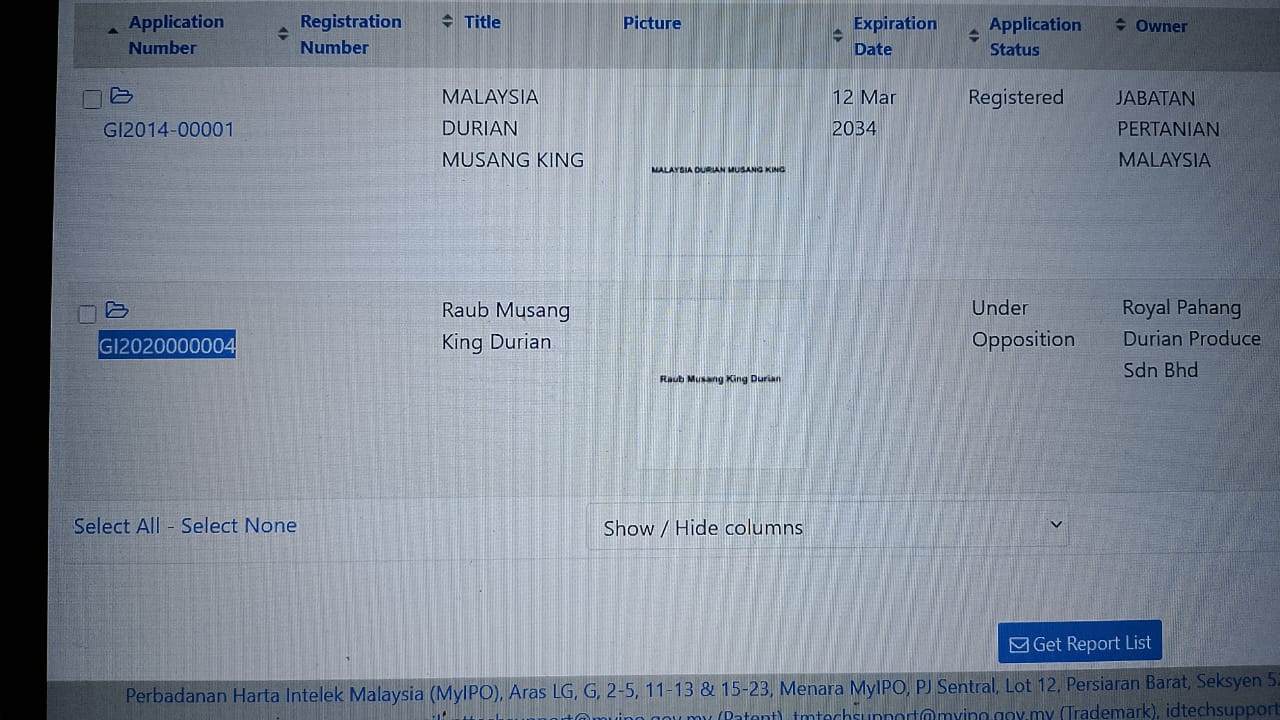
While Raub in Pahang is widely regarded as a premier cultivation area and enjoys strong market recognition among durian enthusiasts, granting a separate GI could raise concerns over exclusivity, potential market confusion, and fairness to producers outside the region. This development underscores a broader regulatory principle: geographical names carry economic value, and regulators must balance authenticity and regional reputation against the need to preserve collective access and prevent monopolisation of origin-linked terms.
What GI protection ensures
- the name “Musang King” remains legally associated with Malaysia
- only durians meeting origin and quality standards may use the designation
- mislabeling or counterfeit use can be challenged
- consumer trust and international credibility are protected
It is also essential to distinguish between a Geographical Indication and a trademark — a distinction frequently misunderstood by entrepreneurs and brand owners. A GI is a collective right shared by qualifying producers and cannot be monopolised. A trademark, by contrast, protects brand identity and may be exclusively owned.
GI vs Trademark — key differences
Geographical Indication
- protects origin and authenticity
- shared by qualified producers
- cannot be exclusively owned
Trademark
- protects brand identity
- owned by a business
- distinguishes commercial source
Businesses therefore cannot claim exclusive ownership of the term “Musang King,” but they can build strong brand equity around it through distinctive names, logos, packaging, storytelling, and quality assurance.
From a legal and commercial standpoint, GI protection strengthens Malaysia’s ability to safeguard authenticity, maintain premium pricing, and prevent reputational harm caused by counterfeit products. From a franchising and licensing perspective, the implications are equally significant. Franchise systems built around durian cafés, dessert chains, specialty retail outlets, or export-driven retail concepts may leverage Musang King’s GI status as a trust anchor — but they must ensure authenticity, compliance, and brand differentiation.
Implications for franchising & licensing
- franchisors cannot claim exclusivity over the GI term
- supply must be authentic and compliant with GI specifications
- franchise disclosure should clarify sourcing and authenticity standards
- regional claims (e.g., “Raub”) must be accurate and not misleading
- brand value must come from proprietary branding and customer experience
- quality control systems are essential to maintain trust and compliance
Beyond conventional franchising, Musang King also invites reflection on emerging models such as the eco-symbiotic franchise — a concept where every part of a raw product is utilised across interconnected business streams. In such a model, the fruit may be sold fresh or processed into pulp and desserts; husks and seeds can be repurposed into compost, biochar, or agricultural inputs; shells may support eco-packaging innovations; and agrotourism or farm-to-table experiences can complement retail and F&B outlets.

By integrating food production, sustainability, and circular resource use, a Musang King ecosystem could create multiple revenue layers while reducing waste and strengthening rural economies. In an era where sustainability and traceability matter as much as taste, such symbiotic models may represent the next evolution of franchise development.
Beyond law and commerce, Musang King resonates culturally. It evokes kampung memories, festive gatherings, roadside stalls, and family indulgence. Perhaps that is why the headline felt both amusing and meaningful — durian sits close to the Malaysian heart. Yet the renewal of GI protection underscores something far more strategic: the protection of a national economic asset.
In today’s global economy, value is not created solely in the orchard. It is created through origin protection, intellectual property strategy, sustainability innovation, branding, and trust. Musang King may spark jokes at the coffee table, inspire debates about whether Raub produces the best fruits, and remain a festive indulgence but its protection ensures Malaysia retains ownership of the authenticity, reputation, and premium market value associated with one of its most iconic agricultural products.