A client recently sent me a WhatsApp message asking for my thoughts on franchise recruitment and onboarding. In my view, franchise recruitment is not merely about finding someone with the financial capacity to take up an outlet. It is a structured process of identifying the right franchisee, assessing suitability, aligning expectations, and ensuring that the franchisee is properly brought into the system through a clear and disciplined onboarding process.
Recruitment and onboarding should therefore be seen as one continuous journey. The first part concerns selection: defining the right profile, attracting suitable prospects, screening them, and carrying out the necessary evaluation and due diligence. The second part concerns transition: once the right candidate is selected, the franchisor must onboard that franchisee properly through documentation, orientation, training, operational preparation, and support activation. If this process is rushed or poorly managed, even a promising franchisee may struggle.
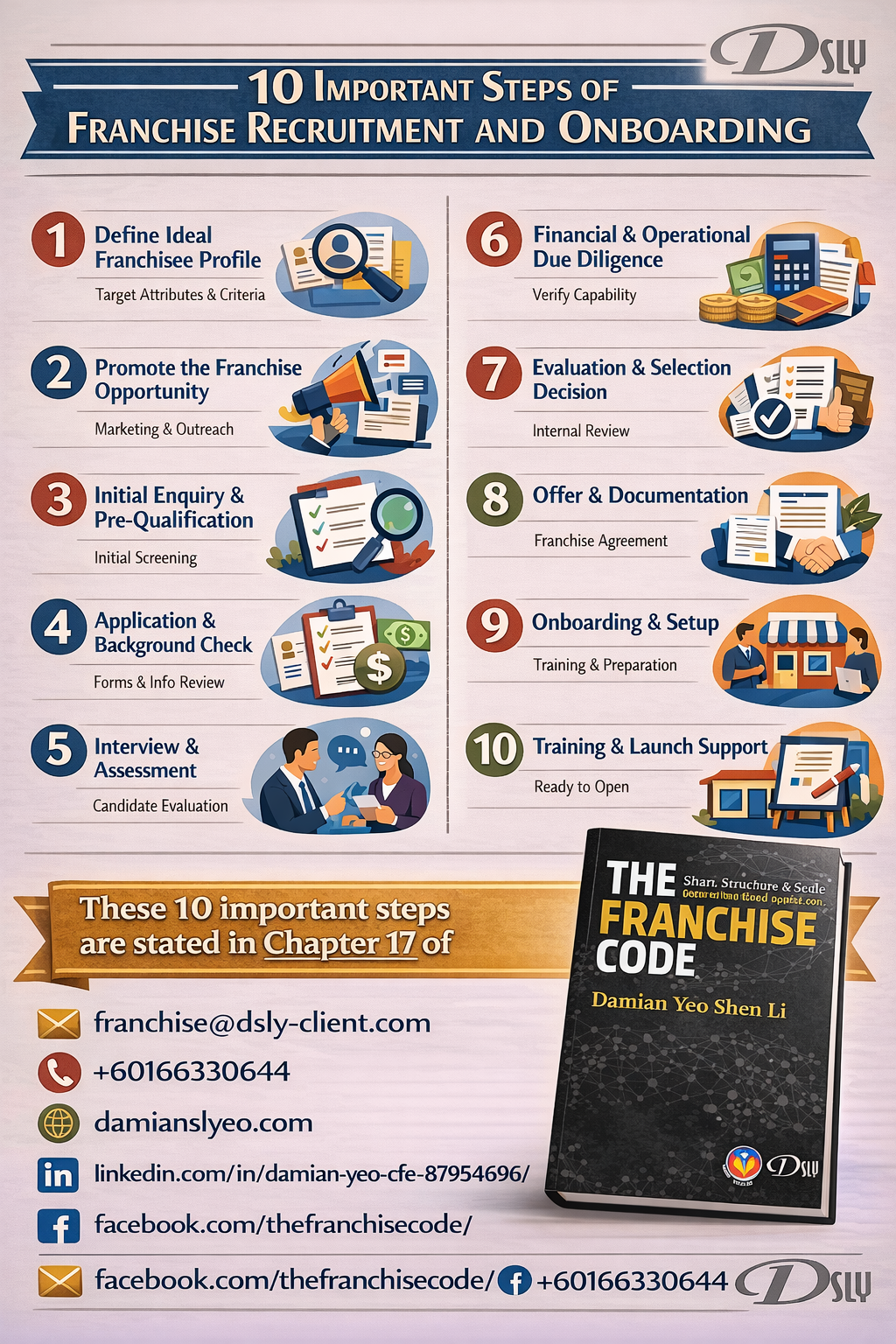
Below is my view on what franchise recruitment and onboarding should look like, set out in 10 important steps. This approach is also consistent with Chapter 17 of The Franchise Code: Start, Structure and Scale Your Franchise in Malaysia.
The 10 Important Steps of Franchise Recruitment and Onboarding
1. Define the ideal franchisee profile
The franchisor must first determine the profile of the person or entity it wants for an outlet. This includes factors such as capital capacity, operational capability, attitude, local knowledge, leadership style, and overall fit with the brand’s values and direction. Without a clear profile, recruitment may become inconsistent and unsuitable candidates may enter the system.
2. Promote the franchise opportunity
The franchise opportunity must then be presented clearly and professionally. This can be done through brochures, decks, websites, exhibitions, roadshows, referrals, and direct outreach. The purpose is not merely to generate enquiries, but to attract serious prospects who understand the nature of the business and the expectations of the franchise system.
3. Initial enquiry and pre-qualification
Once enquiries are received, there should be a first-level filtering exercise to determine whether a prospect meets the basic criteria. This pre-qualification stage helps the franchisor avoid spending unnecessary time on candidates who do not meet the minimum requirements in terms of funding, experience, location, or commitment.
4. Submission of application and background information
If the prospect passes the initial stage, he or she should be required to complete an application form and submit the relevant business, financial, and personal background information. This allows the franchisor to obtain a fuller picture of the prospect before moving into deeper evaluation.
5. Interview and compatibility assessment
Structured interviews should then be conducted to assess the prospect’s seriousness, commitment, mindset, communication style, business acumen, and compatibility with the franchise culture. A franchise relationship is a long-term business relationship, and compatibility is often just as important as financial ability.
6. Financial and operational due diligence
At this stage, the franchisor should verify whether the prospect has the financial strength, practical ability, and commercial readiness to take on and sustain the outlet. This includes reviewing funding capability, understanding of operations, and the prospect’s ability to manage staff, compliance, and day-to-day business demands.
7. Evaluation and selection decision
The franchisor must then internally evaluate the candidate against its own criteria and decide whether the prospect is suitable to proceed. This decision should not be based on emotion or pressure to expand quickly, but on whether the candidate is genuinely capable of upholding the brand and operating the outlet successfully.
8. Offer, clarification, and documentation stage
Once the prospect is selected, the process moves into the formal stage of clarification, expectation-setting, and franchise documentation. This is where timelines, roles, obligations, business terms, and documentation are properly discussed so that both parties proceed with clarity and understanding.
9. Structured onboarding into the franchise system
This is where onboarding truly begins. The selected franchisee must be properly welcomed into the system and guided through orientation, brand familiarisation, outlet setup planning, opening schedules, and operational expectations. Onboarding should be structured and intentional, not casual or rushed.
10. Training, opening preparation, and support activation
The final stage involves delivering the training programme, establishing communication channels, activating the support team, and guiding the franchisee through pre-opening preparations and early-stage operations. This ensures that the franchisee is not left alone at the most critical stage of transition from recruitment into actual business operations.
In summary, franchise recruitment and onboarding are not isolated events. They are part of a disciplined process that begins with identifying the right candidate and continues until the franchisee is properly trained, prepared, and supported to open and operate the outlet. A good franchise system does not merely recruit franchisees; it recruits carefully and onboards responsibly. That is why, as highlighted in Chapter 17 of The Franchise Code: Start, Structure and Scale Your Franchise in Malaysia, onboarding should never be rushed, but must always be tied to training, opening timelines, and support systems.