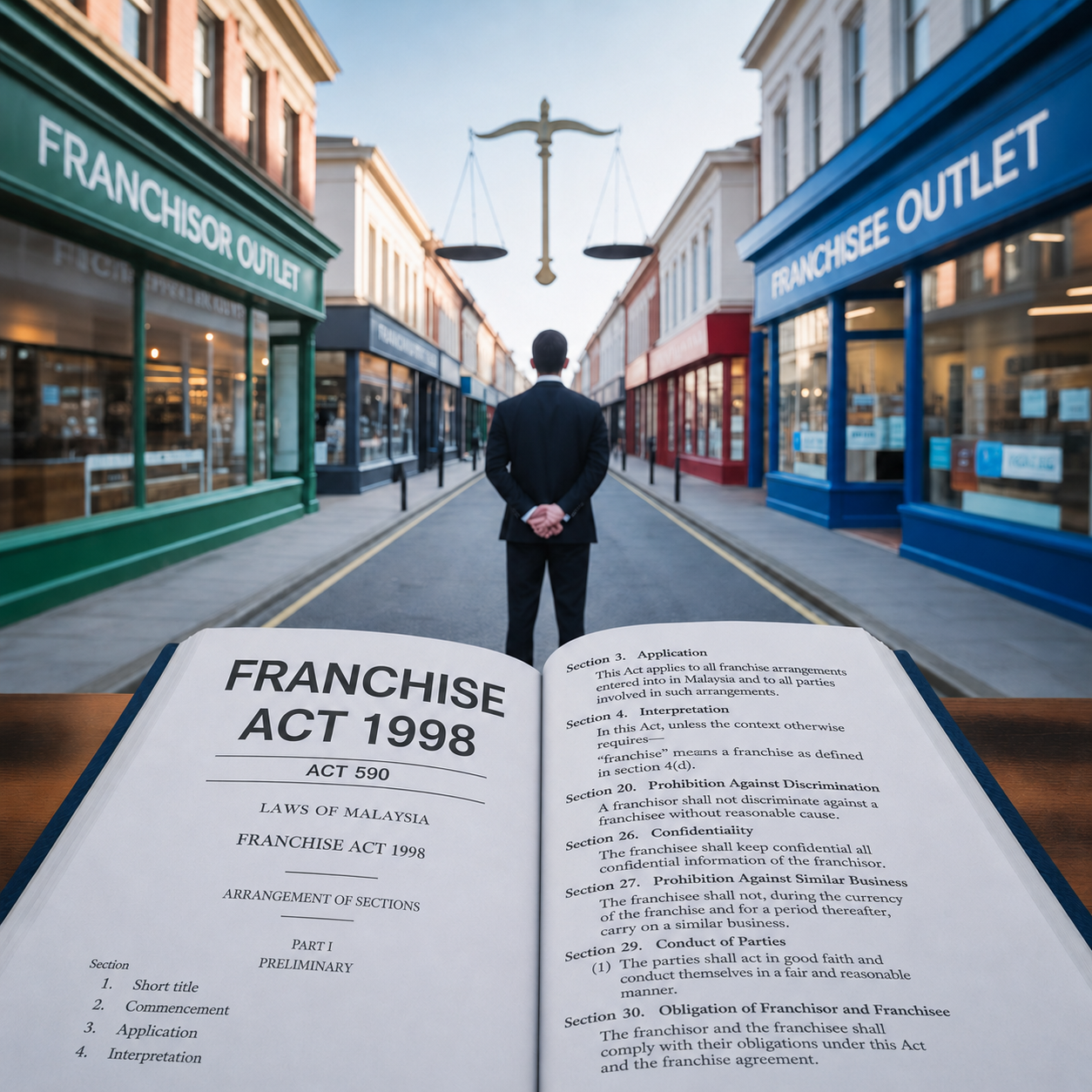
I have received this question on numerous occasions, and just yesterday morning a fellow lawyer asked me:
“Can a director of a franchisor own and operate a franchise outlet under the Franchise Act 1998?”
At first glance, the answer appears straightforward because there is no express provision in the Franchise Act 1998 prohibiting a director or shareholder of a franchisor from owning a franchise outlet.
However, once we begin reading the Act as a whole, the issue becomes considerably more complex.
To date, this issue has not been tested before the Malaysian courts, and therefore any opinion must necessarily be based on the statutory framework rather than judicial precedent.
When I considered the question, four legal issues immediately came to mind.
1. Section 29(3): The Separation Between Franchisor and Franchisee
The first provision that immediately caught my attention is section 29(3) of the Franchise Act 1998, which provides a clear distinction between the franchisor and the franchisee.
The Act requires the franchisee to operate its business separately from the franchisor, and further provides that the relationship between them shall not, at any time, be regarded as a partnership, contract of service or agency.
Although the Act does not prohibit common ownership or common directors, Parliament clearly intended that a franchisee must remain an independent business operator.
This naturally raises several questions.
- Is the franchise outlet genuinely operated independently?
- Does the director-owned outlet receive preferential treatment unavailable to other franchisees?
- Is the outlet merely another branch of the franchisor disguised as a franchise?
- Does the franchisor continue to exercise such extensive control that the statutory separation required under section 29(3) becomes illusory?
Ultimately, the court would likely look beyond the legal structure and examine the commercial reality of the relationship.
2. The Definition of “Franchisor” and “Franchisee” under Section 4 Read Together with Section 30
The second issue concerns the statutory roles created under the Act.
Section 4 clearly distinguishes the role of the franchisor, who grants the franchise, from the franchisee, who receives those rights and operates the business in accordance with the franchise system.
Section 30 further reinforces this distinction by imposing statutory obligations upon the franchisor towards its franchisees.
If the same individual effectively controls both parties, legitimate questions arise.
- Can there truly be an arm’s-length relationship?
- Can the franchisor genuinely discharge its statutory obligations to the franchisee where both are effectively controlled by the same individual?
- Is this truly a franchise relationship, or merely an internal corporate arrangement?
The Franchise Act appears to contemplate two legally distinct parties with different statutory responsibilities.
3. Sections 26 and 27: Confidentiality and Restrictive Obligations
The third issue concerns sections 26 and 27, dealing with confidentiality, trade secrets and restrictions relating to competing businesses.
Ordinarily, these provisions regulate the conduct of franchisees and persons connected with them.
Where a director of the franchisor also owns a franchise outlet, practical concerns arise.
The same individual possesses confidential information in two entirely different legal capacities.
Questions may arise as to:
- the handling of confidential information;
- enforcement of restrictive covenants;
- protection of trade secrets; and
- whether confidential information belonging to the franchisor is being used to benefit one particular franchise outlet over others.
Although these provisions do not prohibit such ownership, they certainly complicate compliance and enforcement.
4. Conflict of Interest and Section 20 – Unreasonable Discrimination Between Franchisees
In my view, this is perhaps the most significant concern.
A director owes fiduciary duties to act in the best interests of the franchisor. I have also written a 10 pages thought on fiduciary duty between franchisor and franchisee.
However, as the owner of a franchise outlet, that same individual also has a personal commercial interest in maximising the profitability of his own outlet.
Conflicts may therefore arise whenever decisions affect franchisees generally, including:
- allocation of territories;
- supply of products;
- pricing and rebates;
- advertising expenditure;
- promotional campaigns;
- operational support;
- distribution priorities; and
- enforcement decisions against franchisees.
This issue is no longer merely theoretical.
Over the years, I have received complaints from franchisees alleging that newly launched products or promotional items were first supplied to outlets that were either owned by persons connected to the franchisor or were perceived to be “franchisor-friendly.”
If those allegations are true, the issue may extend beyond corporate governance into a potential statutory issue under section 20 of the Franchise Act 1998.
Section 20 prohibits a franchisor from unreasonably and materially discriminating between franchisees in relation to the charges offered or imposed for franchise fees, royalties, goods, services, equipment, rentals or advertising services where such discrimination causes competitive harm.
The allocation and supply of newly launched products would arguably fall within the statutory category of goods.
For example, where a director-owned outlet receives:
- earlier access to newly launched products;
- larger quantities of limited stock;
- priority delivery;
- exclusive promotional campaigns;
- preferential pricing; or
- additional marketing support,
that outlet may enjoy a significant competitive advantage over other franchisees operating within the same market.
The disadvantaged franchisees may lose:
- early sales;
- customer traffic;
- promotional opportunities;
- repeat customers;
- market visibility; and
- revenue generated during the initial launch period.
Such circumstances may satisfy the element of competitive harm contemplated under section 20.
However, not every difference in treatment amounts to a contravention of the Act.
The discrimination must be unreasonable, material, and must cause competitive harm.
There may be legitimate commercial reasons for different treatment, including:
- stock availability;
- geographical logistics;
- outlet size;
- historical sales performance;
- participation in pilot programmes;
- operational readiness; or
- other objectively justifiable commercial reasons.
Nevertheless, where no reasonable explanation exists and a director-owned outlet consistently receives preferential treatment, serious questions arise as to whether the franchisor has complied with its statutory obligations.
The evidence may include:
- allocation schedules;
- purchase orders;
- invoices;
- delivery dates;
- stock allocation records;
- pricing structures;
- rebate arrangements;
- internal communications;
- promotional circulars; and
- the franchisor’s own allocation policies.
The existence of a director-owned outlet therefore creates not merely the possibility of a conflict of interest but also the opportunity for discriminatory conduct that may fall within the scope of section 20.
In addition, such conduct may also be inconsistent with section 29(1), which requires both the franchisor and the franchisee to act honestly and lawfully and to endeavour to pursue the best franchise business practices of the time and place.
Conclusion
My preliminary view is that the Franchise Act 1998 does not expressly prohibit a director of the franchisor from owning a franchise outlet.
However, legality should not be determined just by corporate structure.
The more important question is whether the arrangement preserves the statutory separation between franchisor and franchisee, complies with the obligations imposed by the Franchise Act, avoids conflicts of interest, and treats all franchisees fairly and equally.
Where a director-owned outlet receives preferential treatment in product allocation, pricing, marketing support or other commercial benefits without reasonable justification, the issue may move beyond corporate governance and potentially engage section 20 of the Franchise Act 1998.
Ultimately, this remains an open question under Malaysian law. Until the courts have an opportunity to consider the issue, careful corporate governance, transparency and faithful compliance with the Franchise Act remain essential.
Perhaps the real question is not whether a director can own a franchise outlet. Rather, it is whether the franchisor can convincingly demonstrate that every franchisee, including the director-owned outlet, is treated with the same fairness, independence and integrity required by the Franchise Act 1998. Everything has to be in good faith!