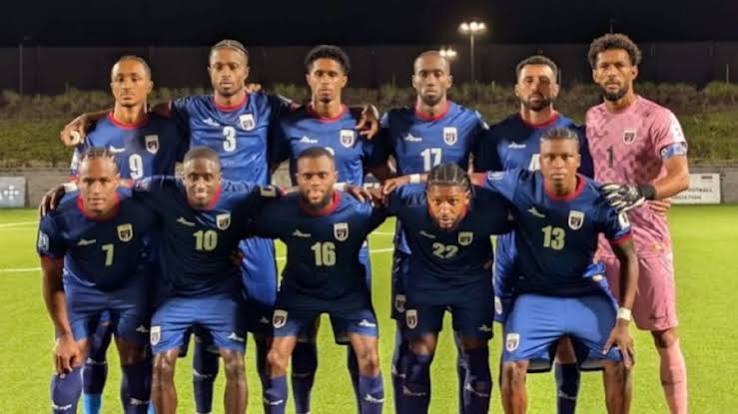
Ever since Cape Verde stood against Spain with a goalless draw, I started reading more about this small island nation.
A nation of approximately 600,000 people, 10 volcanic islands covering 4,033 square kilometers and is heavily urbanized, centered mostly in coastal cities as 80% to 90% statistic describes a serious lack of freshwater and fertile soil. (Do read more, it will surprise you that despite their lacking, corn, sugarcane largely grow in Cape Verde)
On paper, Spain dominated the game. Spain had about 74% ball possession, 27 total shots, 7 shots on target, 11 corner kicks and constant pressure. Cape Verde had only 6 total shots, 1 shot on target and 1 corner kick.
Yet Cape Verde survived, defended, believed and stood firm. To them 0-0 is a good shot at the World Cup.
Their goalkeeper, Vozinha, at 40 years old, became, I believe, one of the stories of the World Cup. Today, I read that his mother, Ana Candida Evora, will be flying to Miami to watch Cape Verde play Uruguay after visa-related issues were resolved through the intervention involving Hakeem Jeffries (Democrat minority leader), Secretary of State Marco Rubio and the U.S. State Department.
That is why the result felt bigger than just football.
Cape Verde, or Cabo Verde, is a small African island nation in the Atlantic. Yet it graduated from the United Nations’ Least Developed Country category in 2007 and is now recognised as a developing nation. Very few countries have achieved that graduation, and in Africa, that is momentous where now there are 33 least developed countries out of 54 Africa nations. (Asia there are 49 sovereign nations. Only 8 countries (Yemen, Myanmar, Timor Laste, Bangladesh, Nepal, Cambodia, Laos and Afghanistan) are on the list.
So Cape Verde is not only an underdog in football but a successful story.
Cape Verde teaches me five franchise lessons which I am about to share here.
First, small is not weak. A small brand can still be strong if it is focused. Mighty Spain took Cape Verde for granted. Striker Mikel Oyarzabal was completely starved of service, famously failing to touch the ball even once during the first 30 minutes of the match (Sky Sport). I mean, sad that Yamal and Williams were benched due to injury but Spain had, Daniel Olmo isn’t it?
Cape Verde is small, but it is not careless. They knew they are having a difficult time, so let us play a wall. Create a Defence system and make it impenetrable. And that works!
In franchising, a small brand with two or three good outlets, proper SOPs, training, brand control and unit economics may be better than a big brand with no discipline. Make sure the SOP, brand value, good taste is water tight.
Second, identity matters. Cape Verde has a story, an island nation, resilience (based on its geography and demographics), music, tourism and now football. It is not just a country appearing in the World Cup. I believe, nobody knows what nation is this.
So when they drew with mighty Spain, people suddenly want to know more about Cape Verde. They are not only watching a football team; they are discovering a nation.
This is the same with franchising.
A franchise brand cannot only sell a product. If it only sells coffee, chicken, noodles, desserts, education, fitness or services, then it becomes easily replaceable. There will always be another shop selling something similar, cheaper or louder. Example Mixue or Lucky where they storm into Malaysia offering cheaper drinks.
But when a brand has identity, it becomes memorable. Identity tells people who you are, why you exist, what you stand for, and why customers should return. It gives meaning to the logo, the colours, the outlet design, the menu, the service style, the uniform, the slogan/jingle, the story and even the way staff speak to customers.
Third, governance creates trust. Cape Verde’s graduation from the UN Least Developed Country category is a major achievement for a small African nation.
In franchising, governance is the equivalent of TRUST. People buy trust. They buy belonging. They buy the feeling of being connected to something. Proper agreements, disclosure documents, manuals, training, audit, compliance and support – tiptop. Try the Getta Coffee Gold Latte at Getta Coffee for example.
Fourth, systems beat size. A football team without a system will collapse even if it has good players.
I read that Cape Verde played with a 4-2-3-1 system and shifted into a 4-5-1 when defending, with the midfielders dropping deeper to protect the defence. Interestingly, they were also careful. Spain committed 10 fouls, perhaps because they were under pressure, whereas Cape Verde committed only 1 foul. Think about that.
A franchise without a system will also collapse even if the product is good. The outlet must not depend only on the founder’s personal touch. It must be repeatable.
Fifth, efficiency beats domination. Spain dominated possession, shots and corners, but Cape Verde still achieved the result because they were disciplined and efficient. In franchising, the biggest brand, the most outlets or the loudest marketing does not always win. It also takes resilience, patience and hope.
What is important is whether the system protects the brand, whether the franchisee can survive pressure, and whether the customer continues to trust the experience.
In conclusion, Cape Verde teaches me that greatness is not reserved for the biggest and strongest. A small nation, like a small brand, can stand with giants if it has identity, governance, discipline and a working system.
To anybody venturing into franchising, do not chase size first. Chase quality, discipline of the franchisor and franchisee, consistency for every customer, and trust in every transaction.
So to the smallest brand out there, yes, I am talking about you.
Let us do a “Cape Verde” franchise.