
The launch of Malaysia’s National Food Security Policy 2030, or Dasar Keterjaminan Makanan Negara 2030, January 2026 is an important reminder that agriculture can no longer be seen merely as planting, harvesting and selling.
Food security is not just having enough food. It is also about the quality of food, the safety of food, the accessibility of food, the sustainability of the food system, and the resilience of the entire agrofood supply chain.
This is where Malaysia must start looking at agriculture differently.
In the early years of Malaysia’s development, we were fundamentally an agricultural nation. Rubber, palm oil, paddy, fisheries, livestock and smallholder farming were not merely economic activities; they formed part of the livelihood, identity and survival of many Malaysian communities.
Agriculture was once the backbone of the nation. It fed families, supported rural economies and created the foundation for national development.
However, as Malaysia industrialised in the 70s and modernized in the 80s, agriculture was sometimes treated as a traditional or secondary sector, while manufacturing, services, technology and urban development took a more centre stage, especially, presently in the 21st century.
But the National Food Security Policy 2030 reminds us that agriculture can no longer be viewed as something old-fashioned or backward. Agriculture must be reimagined as a modern, structured, technology-driven and value-added agrofood ecosystem.
For many years, agriculture has often been viewed from a traditional lens. A person owns land. He plants crops. He waits for harvest. He sells the produce. If the price is good, he earns. If the price drops, he suffers. If there is disease, weather disruption, labour shortage, logistics cost or middlemen pressure, the farmer carries the burden.
This model may have worked in the past, but the modern agrofood economy requires something more structured.
The question today is no longer, “What can we plant?”
The better question is, “What complete agro-business system can we build around what we plant?”
This is important because many agricultural businesses are still fragmented. A pineapple plantation is treated only as a pineapple plantation. A durian orchard is treated only as a durian orchard. A fish pond is treated only as a fish pond. A vegetable farm is treated only as a vegetable farm. But in truth, agriculture has the potential to be much more than that.
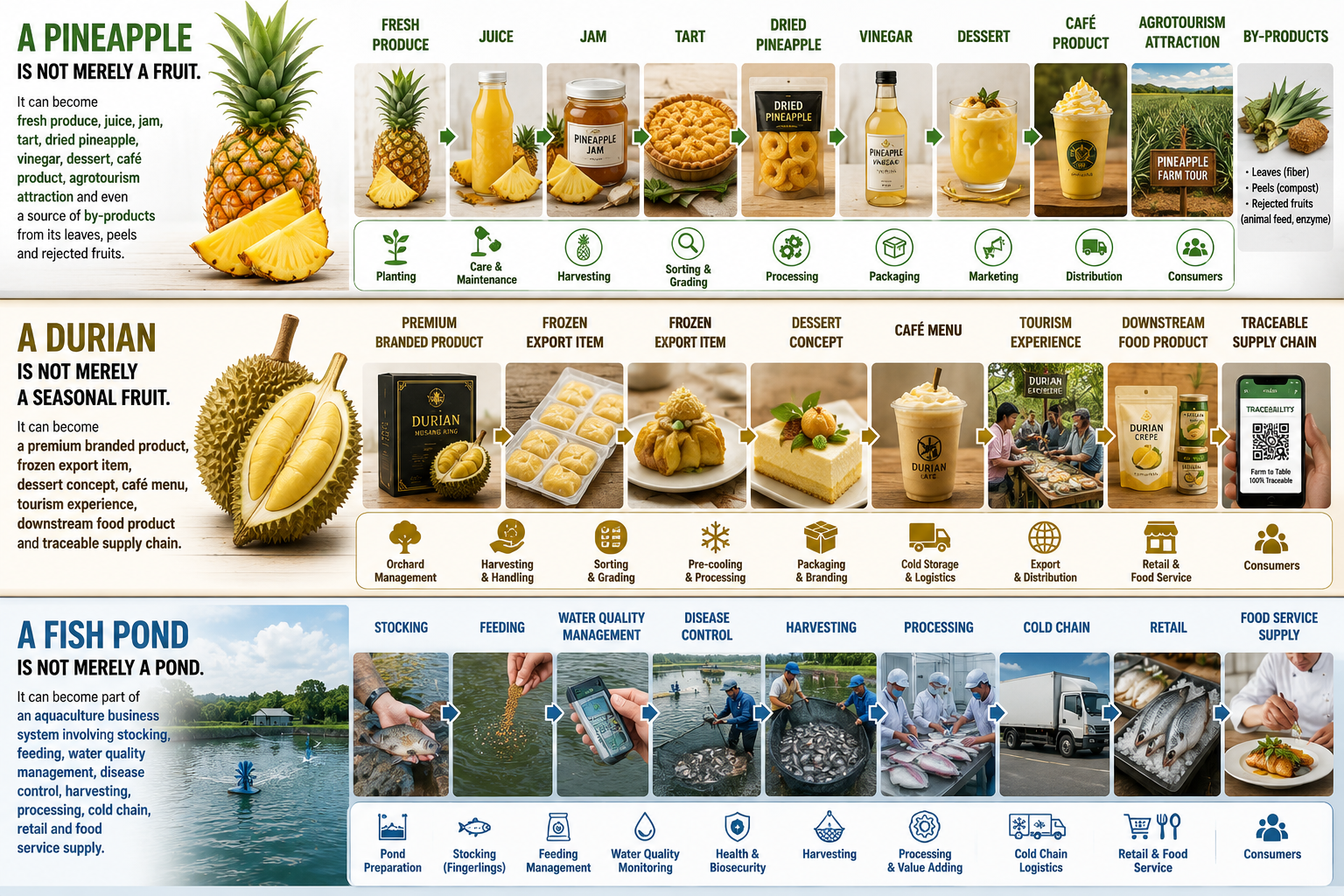
This is why agro business must move from a single-activity model into an ecosystem model.
The old model is simple:
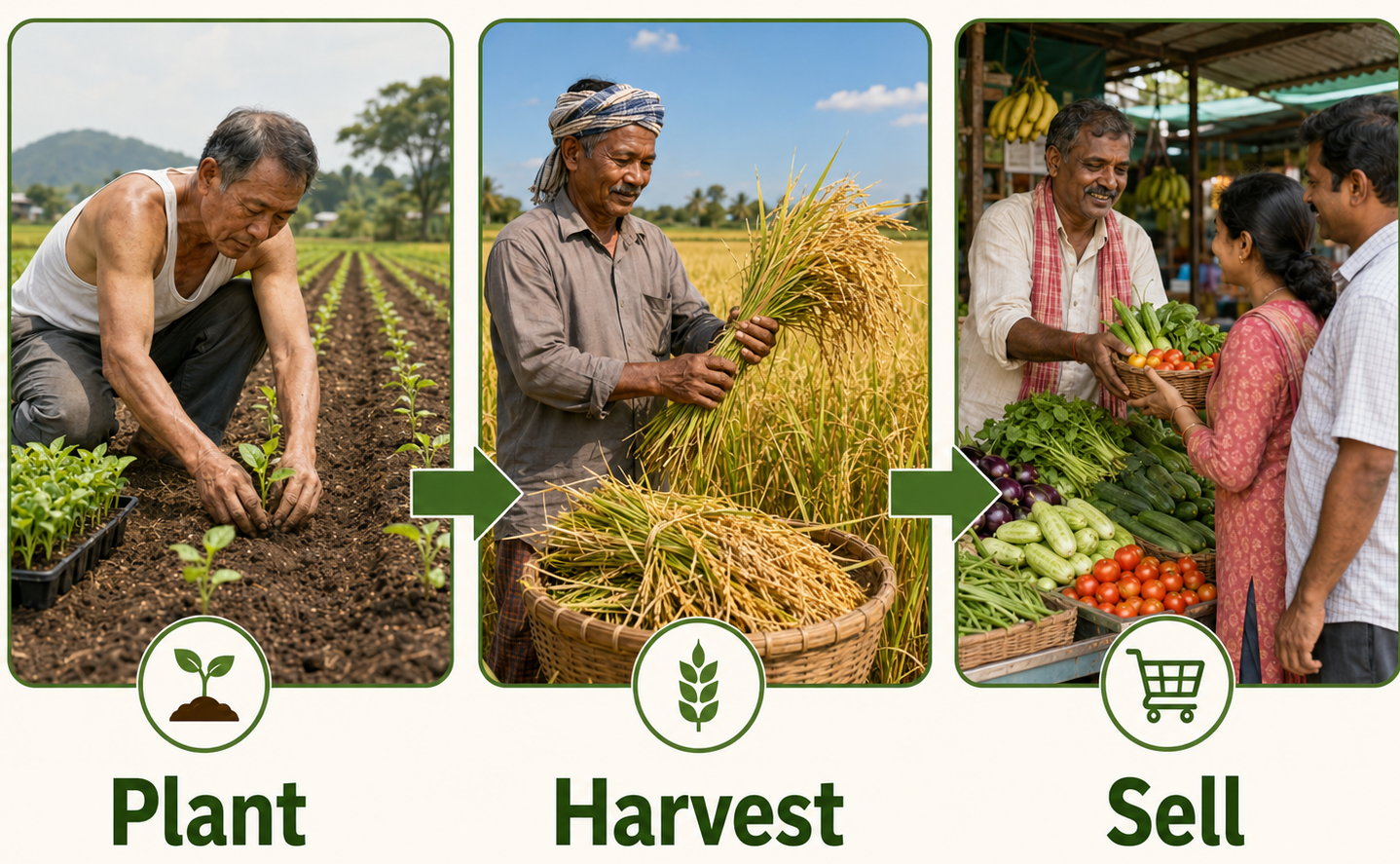
But the new model must be:
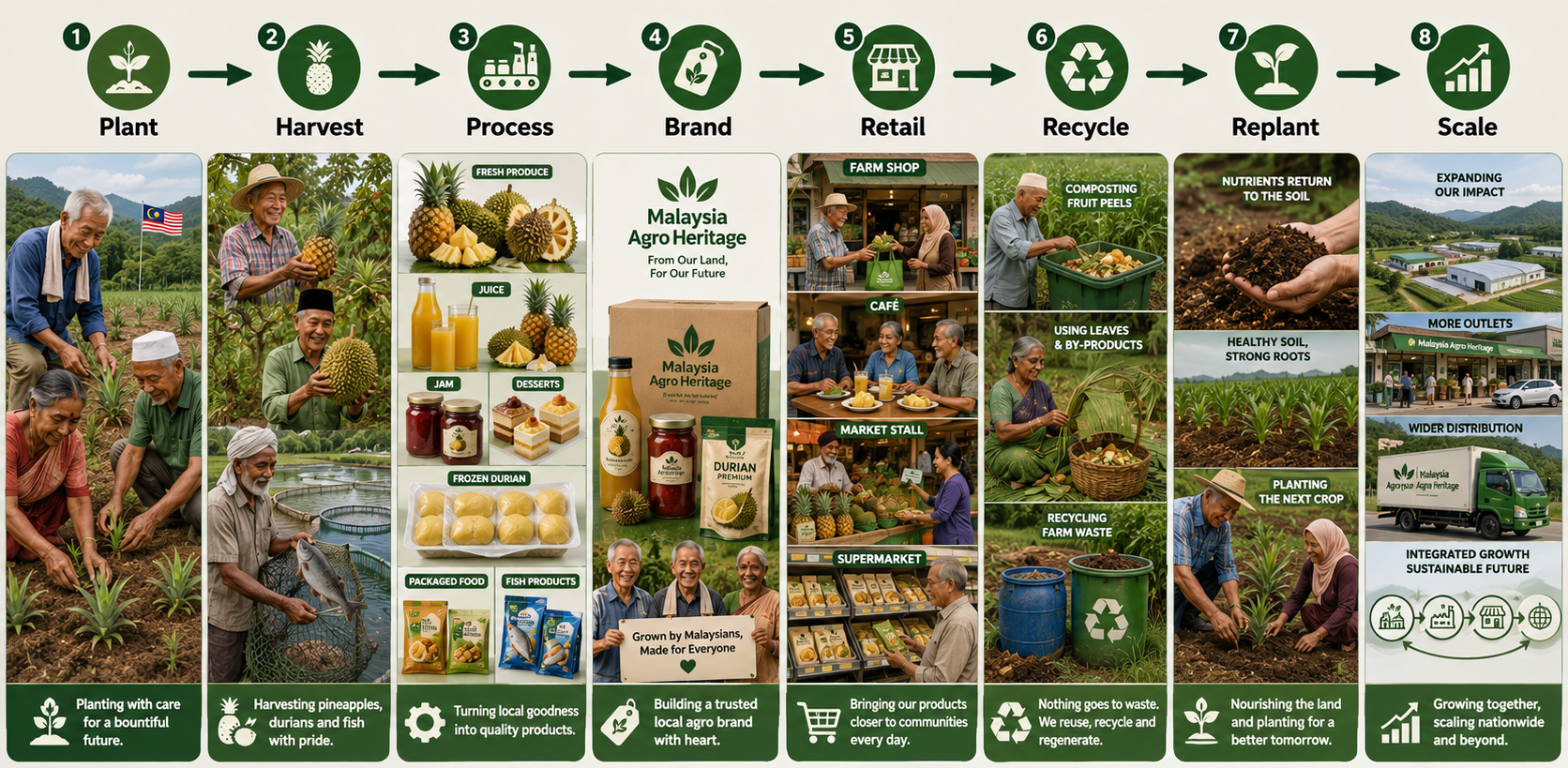
Plant → Harvest → Process → Brand → Retail → Recycle → Replant → Scale
Are there any business model for Agrofood?
The usual we hear is Contract Farming or a hybrid to it. It is important that we must also recognise that agriculture has never operated under one single business structure. This structure evolves from one era to another like the Pawah system during pre-colonial in Malaysia.
Agrofood business may take many forms. Some farmers own their own land and sell directly to the market. Some operate through middlemen. Some enter into supply arrangements with wholesalers. Some become part of contract farming programmes. Some operate through cooperatives society. Some enter into joint ventures with landowners, investors or agro companies.
One of the most common structures is contract farming.
In a contract farming model, the farmer or grower produces agricultural products according to an agreed arrangement with a buyer, aggregator, government agency or private company. The contract may deal with the type of crop, quantity, quality, supply schedule, technical requirements, price mechanism and market access.
This model is important because one of the biggest problems in agriculture is not only production but marketing and promotion.
A farmer may be able to plant and harvest, but the farmer may not always have stable market access. Without market access, the farmer is exposed to price fluctuation, oversupply, wastage and middlemen dependency.
Contract farming attempts to reduce this problem by linking production with a buyer or marketing channel.
In Malaysia, contract farming has been part of the agrofood landscape for many years. For example, FAMA’s contract farming implementation refers to crops such as durian, pineapple, banana, watermelon, papaya, mango, coconut, coffee and others, with purchase pricing mechanisms that may include fixed purchase price or current market price supported by a floor price.
This is already a form of system thinking.
It recognises that agriculture cannot depend on planting alone. It must also be connected to market access, pricing, collection, grading and distribution.
However, contract farming still has its limitations.
It may solve the marketing issue, but it may not always solve the full business ecosystem. It may not necessarily create a brand. It may not create downstream products. It may not create retail formats. It may not create tourism value. It may not address waste utilisation. It may not provide a complete replicable business format.
This is where hybrid agro models become relevant. A hybrid agro model may combine several structures at once. For example:
(a) Landowner model
The landowner provides land, pond, orchard or plantation area.
(b) Contract farming model
The grower or operator produces according to agreed standards and sells to an identified buyer or aggregator.
(c) Management model
A technical operator manages the farm using proper SOP, technology, feed, fertiliser, harvesting and quality-control systems.
(d) Processing model
The produce is processed into value-added products such as juice, jam, dried fruit, frozen durian, sauces, snacks or ready-to-eat items.
(e) Retail model
The products are sold through branded kiosks, cafés, farm shops, online platforms, supermarkets or export channels. This is usually created via a distributorship model.
(f) Waste-utilisation model
Agricultural waste is converted into compost, animal feed, biomass, fibre or other circular-economy outputs.
(g) Franchise model
Once the system is proven, documented, branded and replicable, parts of the ecosystem may be franchised.
This is why the future of agro business may not be purely contract farming or purely franchise. It may be hybrid.
One of the gravest mistakes is to force every agro project into a franchise structure from day one.
Some agro projects should begin as contract farming. Some should begin as a licence or operating agreement. Some should begin as a joint venture. Some should begin as a cooperative or cluster farming model. Some should only become franchise after the business system has been proven.
This distinction is important.
If a person merely owns land and allows another person to plant, that is not necessarily a franchise.
If a person merely owns ponds and allows others to use those ponds, that is not necessarily a franchise.
If a company merely collects money from participants and promises returns, that may not be franchise at all. It may raise investment or regulatory concerns.
This is something I want to stress in developing agro business models, one important caution must be stated. Not every agro project should be presented as a business expansion model.
If the arrangement is merely that a person contributes money into a pond, farm, tree, livestock project or plantation and then waits for a promised return, the structure may raise regulatory concerns. It may look more like an investment scheme, managed farming scheme, sharefarming scheme or interest scheme.
This is especially so where the participant is passive, does not operate the business, does not manage the farming activity, and relies entirely on another party to generate returns.
A proper agro business structure should create real operators, not merely collect investors.
The participant must have a genuine role in the business system. He should operate or manage a defined agro unit, follow SOPs, undergo training, comply with quality control and participate in the production, processing, retail or market-access structure.
Therefore, before any agro project is promoted to the public, we must first ask:
Is this person an operator, or merely an investor? If he is merely an investor, then the structure must be reviewed carefully because it may raise regulatory issues. But if he is operating a real agro business under a proven system, training, SOP, quality control and market structure, then it becomes a more sustainable and defensible model.
But if the agro business has a brand, operating system, training, SOP, supply chain, quality control, processing method, retail channel, waste-utilisation process and replication model, then franchising becomes relevant.
As such, one should consider an Agro franchise that evolve into an Eco-Symbiotic Franchise Theory which should not be seen as rejecting contract farming. Instead, it builds upon it.
Contract farming connects the farmer to the buyer.
Hybrid agro systems connect the farmer to land, technology, management, processing and market.
Eco-Symbiotic Franchising goes one step further. It connects planting, production, processing, branding, retail, downstream products, waste utilisation and sustainable livelihood into one replicable franchise ecosystem.
Is there such thing as an Agro Franchise?
Franchising is often associated with fast food, cafés, convenience stores, education centres and retail outlets. But at its heart, franchising is not about burgers, coffee or tuition. Franchising is about systemisation.
A franchise takes a business that works and converts it into a replicable model. It documents the system. It trains operators. It controls quality. It protects the brand. It standardises the customer experience. It builds a supply chain. It allows expansion through disciplined replication.
Agriculture needs this discipline.
Many agro projects fail not because the land is bad or the crop is bad, but because the system is incomplete. There may be planting, but no branding. There may be harvesting, but no processing. There may be production, but no retail channel. There may be waste, but no waste-utilisation model. There may be good produce, but no market structure.
This is why agro farming must evolve.
Agro farming today should not merely mean planting on land. It should include farm planning, technology adoption, input control, production standards, food safety, packaging, branding, market access, downstream products, waste management and possibly agrotourism.
For example, a pineapple agro farm may have several layers.
The first layer is planting. This involves seedlings, land preparation, fertilisation, irrigation, harvesting time and quality control.
The second layer is processing. Pineapple can be processed into juice, tarts, jam, dried fruit, snacks, sauces or beverages.
The third layer is retail. Pineapple products can be sold through kiosks, cafés, supermarkets, online platforms, tourist centres and export channels.
The fourth layer is waste utilisation. Peels, crowns, leaves and rejected fruits can potentially be converted into compost, feed, biomass, fibre or other circular-economy outputs.
The fifth layer is experience. The plantation itself can become a farm visit, education centre, agrotourism site or ESG-linked rural entrepreneurship project.
This is no longer a simple farm. This is an agro ecosystem.
The same can apply to durian. A durian orchard should not only depend on roadside sales during the season. It can build a branded grading system, frozen durian supply, durian café, dessert products, export readiness, farm tourism and downstream production.
Even fish ponds can be structured this way. A pond is not franchisable merely because it exists. But an aquaculture system can be franchisable if there are proper SOPs, stocking rules, feed control, water quality management, disease control, training, harvesting standards, central marketing and brand discipline.
This leads me to what I call the Eco-Symbiotic Franchise Theory.
What is Eco-Symbiotic Franchise
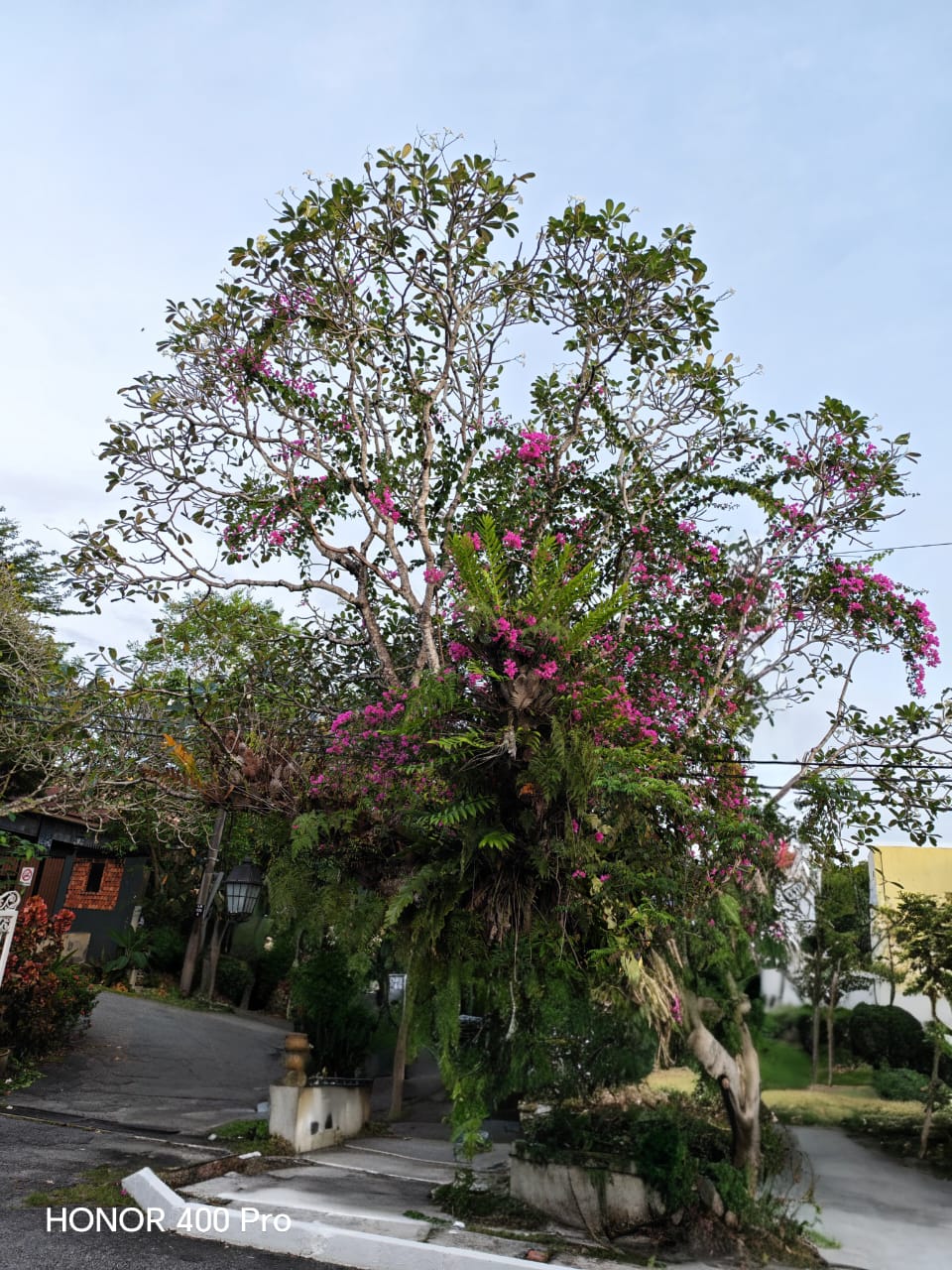
The above picture is taken at my church is PJ. This picture shows a large host tree covered with other living plants, namely bougainvillea, growing over and around the tree together with Ferns and hanging greenery, likely epiphytic plants that grow on another plant. The ferns and other plants grow on the tree, using it as support. They do not directly take food from the tree like parasites. Instead, they obtain moisture and nutrients from rainwater, fallen leaves, dust, air, and decomposed organic matter trapped between the branches. The bougainvillea is likely using the tree as a natural trellis. It climbs toward sunlight and spreads its flowers across the host tree.
Scientifically, this is a good example of an epiphytic and symbiotic plant community.
The tree becomes a small ecosystem by itself. It supports insects, birds, fungi, microorganisms, decomposing leaves, and secondary plants. This is nature showing that one living structure can support many other forms of life. It is not just “one tree”; it becomes a living platform, a natural ecosystem, and a regenerative habitat.
In my book, The Franchise Code: Start Structure & Scale Your Franchise in Malaysia, Eco-Symbiotic Franchise at Page 33, I said that, it is inspired by biological symbiosis, where interconnected business units work together in a sustainable, cooperative, and mutually beneficial system. Eco-Symbiotic franchise ensures that each franchise component support and enhances the others much like organisms in nature that share resources, reduce waste and optimize survival.
The theory is simple:
Do not franchise the land.
Do not franchise the tree.
Do not franchise the pond.
Franchise the ecosystem.
An eco-symbiotic franchise is an agricultural franchise model where planting, production, processing, branding, retail, downstream products and waste utilisation are connected into one business ecosystem.
The word “eco” refers to ecology, sustainability and the natural cycle of agriculture.
The word “symbiotic” refers to how each part supports the other.
The plantation supports the product.
The product supports the brand.
The brand supports retail.
Retail creates demand.
Demand supports farmers.
Production creates waste.
Waste is converted back into value.
That value supports the next planting cycle.
This is the symbiosis.
In this model, nothing should be viewed in isolation. The land is important, but the land alone is not the business. The crop is important, but the crop alone is not the brand. The harvest is important, but the harvest alone is not the value chain.
The real value lies in connecting all parts of the system.
This is also where franchising becomes useful. If an agro ecosystem can be standardised, documented, trained, monitored and replicated, then it may become franchisable.
But we must be careful. Not every agriculture project is automatically a franchise
If a person merely says, “Invest in one acre and receive returns,” that is not necessarily a franchise. If a person merely says, “Pay money and I will manage the farm for you,” that may look more like an investment scheme, joint venture or managed farming arrangement.
A true agro franchise must involve a real operating system. The franchisee or operator must play a genuine role in the business. There must be training, SOP, brand, quality control, ongoing support, market access and clear responsibility.
Therefore, the Eco-Symbiotic Franchise Theory is not just dressing up agriculture as franchise.
It is about building agriculture properly so that it can be franchised responsibly.
In my view, Malaysia needs this approach because our national food security agenda cannot be achieved by production alone. We need stronger systems. We need better income for farmers and we need more agropreneurs. We need local produce to become branded products. We need downstream processing. We need waste reduction. We need retail channels. We need food safety. We need technology. We need sustainability.
This is why agriculture must move from commodity thinking to ecosystem thinking.
A pineapple should not end at the plantation.
A durian should not end at the orchard.
A fish should not end at the pond.
Each agricultural produce should be seen as the starting point of a wider agrofood franchise ecosystem.
The National Food Security Policy 2030 confirms that Malaysia’s agriculture cannot remain as a fragmented planting activity. It must become an integrated agrofood system. This is precisely where the Eco-Symbiotic Franchise Theory becomes relevant: not franchising the land, not franchising the tree, but franchising the ecosystem that connects production, processing, retail, waste utilisation and sustainable livelihood.
ARE THESE JUST WORDS, NOT REALLY. WE HAVE A PLAN
That, to me, is the future of agro franchising.