A recurring question in Malaysian franchise law is whether a business arrangement described as a licensing model may nevertheless amount, in substance, to a franchise under the Franchise Act 1998.
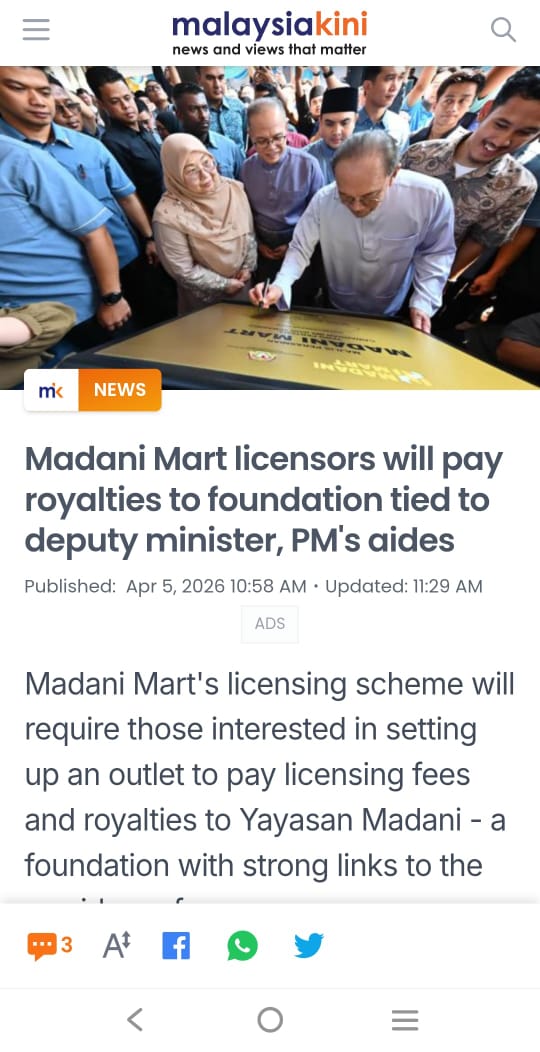
That question arises squarely in the context of Madani Mart. The publicly circulated FAQ states that Madani Mart is not using the franchise concept “buat masa ini” and instead adopts a licensing model, with Yayasan Madani as licensor, the operator as licensee, payment of licensing fees and royalties, and Yayasan Madani providing training, guidance, performance monitoring, marketing strategy, system management and supply-chain development. The FAQ also refers to mandatory SKUs and supplier/ecosystem control, albeit with some flexibility in sourcing.
In my view, the proper Malaysian legal analysis is not determined by the label “licence” alone. The real question is whether the arrangement contains the statutory elements of a franchise. If it does, then the Act may apply notwithstanding the terminology used by the parties.
1. The Malaysian legal test is substance, not description
Section 4 of the Franchise Act 1998 defines a “franchise” very broadly. It covers a contract or agreement, whether express or implied, oral or written, under which the franchisor gives the franchisee the right to operate a business according to a system determined by the franchisor, gives the right to use the franchisor’s mark, trade secrets, confidential information or intellectual property, retains the right to exercise continuous control over the operation of the business, and receives a fee or other form of consideration in return.
This means Malaysian law looks to the substance of the arrangement, not merely the heading of the agreement. A so-called licence, operator agreement, collaboration agreement or strategic partnership may still fall within the Act if the required legal features are present. That approach is reflected not only in the statutory wording, but also in later Malaysian case law where courts examined the real commercial arrangement and not the label alone.
The Madani Mart Business Model can be found here https://www.madanimart.com.my/business-model-expansion
2. Why Madani Mart appears franchise-like in substance
On the face of the FAQ, Madani Mart appears to exhibit several of the classic elements of a franchise.
First, there is a clear grant of the right to use the Madani Mart brand. The FAQ states that Yayasan Madani is the owner of the brand and gives operators or licensees permission to use that brand in their business. That corresponds with the statutory requirement concerning the use of a mark or intellectual property.
Second, the FAQ describes more than a bare trademark licence. It refers to training, guidance, monitoring, marketing strategy, system management and supply-chain development. Those are strong indicators of a structured business system determined and supported by the brand owner.
Third, the FAQ suggests the existence of continuous control, which is often the decisive hallmark of a franchise. Mandatory SKUs, ecosystem requirements, performance monitoring and supplier-related parameters point towards ongoing operational control rather than mere permission to use a name. Even if some sourcing flexibility exists, that does not necessarily negate the overall structure if the core elements remain present.
Fourth, the FAQ expressly states that operators or licensees will pay licensing fees and royalties. Payment of continuing consideration for the right to operate under the brand and system is one of the central statutory features of a franchise.
Accordingly, the stronger legal view is that Madani Mart is at least franchise-like in substance, even though it is presently described in public materials as a licensing model.
3. Registration under section 6 is mandatory unless exempted
Section 3 of the Act states that the Franchise Act 1998 applies throughout Malaysia to the sale and operation of any franchise in Malaysia. Section 6(1) then provides that a franchisor, or a foreign person approved under section 54, must register the franchise with the Registrar before carrying on franchise business or making an offer to sell the franchise. Section 6(2) further provides that failure to comply is an offence, unless exempted by the Minister under section 58.
This is important. If an arrangement is in truth a franchise, the legal starting point is not that parties are free to avoid the Act simply by calling it a licence. The legal starting point is that the arrangement falls within the Act and the statutory compliance regime must be considered.
4. ALL IS NOT LOSS for the MADANI GOVERNMENT – The stronger alternative argument: regularisation by Ministerial exemption under section 58
If Madani Mart is regarded as franchise-like in substance, the more coherent legal argument is not to deny its franchise characteristics at all costs. The stronger alternative argument is that the arrangement may be regularised through the Minister’s power of exemption under section 58, read together with section 6.
Section 58 provides that the Minister may, by order published in the Gazette, exempt any person, class of persons, business or industry from all or any provisions of the Act, subject to such conditions as the Minister thinks fit to impose. In other words, the Act itself contemplates that there may be cases where exemption from statutory compliance is appropriate.
The critical point, however, is that an exemption under section 58 does not convert a franchise into a non-franchise. Rather, it assumes that the Act may apply, but relieves the relevant person, class, business or industry from compliance with particular provisions if a valid Gazette order is made. Therefore, until such an exemption is actually granted and gazetted, the section 6 registration obligation remains in place.
So, in Malaysian legal terms, a better route would be to say this: even if Madani Mart is in substance a franchise, it may potentially be lawfully regularised by Ministerial exemption under section 58, instead of being denied as a franchise merely by form or label.
5. Can a foundation or Yayasan be a franchisor?
In principle, my answer is yes.
Section 4 defines “person” broadly to include a natural person, corporation, partnership, association, firm, joint venture or trust. That is significant because it means the Act is not limited only to a private limited company or to an individual human being. If a foundation or yayasan is legally structured in a way that places it within one of those recognised categories, and it has the legal capacity to own rights and enter into contracts, there is a respectable statutory argument that it may act as a franchisor.
Accordingly, a foundation is not automatically excluded merely because it is called a “foundation”. The better inquiry is whether, in law, it falls within the statutory meaning of “person”, whether it has legal capacity, and whether it properly owns or controls the relevant brand, system and contractual rights.
That said, there is an important practical qualification. The current KPDN/KUSKOP/MyFEX franchisor registration checklist for local entities appears to contemplate registration through an SSM-registered Sdn Bhd or Enterprise, together with the usual supporting documents such as the franchise agreement, operation manual, training manual and trademark certificate. That administrative practice may be narrower than the statutory wording itself.
So while the statutory interpretation supports the possibility that a foundation may be a franchisor, the administrative route may still require close engagement with the Registrar or an exemption strategy under section 58 if the entity does not fit neatly into the standard registration pathway.
6. Malaysian case law: non-registration can make a franchise-like licence illegal and void ab initio
This is where the legal risk becomes serious.
Malaysian courts have repeatedly held that where an agreement is, in substance, a franchise but has not been duly registered, the agreement may be illegal, unlawful, void and unenforceable from the outset.
In Dr H K Fong Brainbuilder Pte Ltd v SG-Maths Sdn Bhd & Ors, the Court of Appeal affirmed that the so-called Master Licence Agreement was in truth a franchise under the Franchise Act 1998. The Court agreed that the court was not bound by the label chosen by the parties, and further held that because the franchise had not been registered, the agreement was illegal and void under the Contracts Act 1950 and unenforceable. The illegality also tainted the related guarantee and power of attorney.
That case is especially important because it reinforces two propositions at once. First, a court will look at the substance of the arrangement rather than the words used in the agreement. Second, once the arrangement is found to be a franchise, registration is imperative, and non-registration can render the entire transaction void for illegality.
Earlier Malaysian authority points in the same direction. In SP Multitech Intelligent Homes Sdn Bhd v Home Sdn Bhd, the High Court held that the franchise agreement was unlawful and void ab initio because the franchisor had contravened the Act, and the court ordered the refund of payments and benefits received. The facts, as later summarised by Malaysian practitioners, show that the agreement had been entered into before approval of registration was obtained, and that this statutory non-compliance tainted the agreement with illegality.
Likewise, Tea Delights (M) Sdn Bhd v Yeap Win Nee is regularly cited in Malaysian franchise commentary as authority for the proposition that failure to register may render the franchise agreement void ab initio, with restitutionary consequences following.
More recent cases have extended this reasoning to agreements expressly framed as licences in Janet Ooi Hui Ming v STC Management Sdn Bhd & Anor, the High Court is cited as an example of the court scrutinising whether an arrangement said to be a licence was in truth a franchise for purposes of the Act.
Similarly, in Cheah Yee Chen & Ors v Safeway Solutions Sdn Bhd & Ors, the High Court reportedly found that agreements labelled as licence agreements were in reality franchise agreements because the core franchise elements were present. Commentary on the case notes that transgression of the statutory requirements taints such agreements with illegality and voidness.
The same principle had already surfaced in Munafya Sdn Bhd v Profquaz Sdn Bhd, where the High Court was reported to have held that a licence agreement can qualify as a franchise agreement and that a licensor cannot offer or provide such a franchise in Malaysia until it is duly registered.
The cumulative Malaysian position is therefore clear: if a so-called licence agreement satisfies the statutory definition of a franchise, and it is not properly registered or validly exempted, there is a real risk that the agreement will be held illegal and void ab initio.
7. The practical implication for Madani Mart
Applied to Madani Mart, the issue is not simply whether the public FAQ prefers the word licensing over franchising. The real issue is whether the legal and operational structure, taken as a whole, falls within section 4 of the Franchise Act 1998. If it does, then the Malaysian case law shows that non-registration is not merely a procedural defect. It may go to the legality and enforceability of the arrangement itself.
That is why the legally safer conversation is not whether the arrangement can be kept outside the Act by drafting language alone. The safer conversation is whether it should be registered, or, if there are public-policy and structural reasons not to do so in the ordinary way, whether a Ministerial exemption under section 58 should be sought and properly gazetted.
8. Conclusion
In Malaysia, the question whether a model is a franchise is one of substance over label.
If a business model grants the right to operate under a defined system, permits use of the brand or intellectual property, reserves continuous operational control, and requires payment of fees or royalties, it may well fall within section 4 of the Franchise Act 1998 even if it is described publicly as a licence.
On the publicly available materials, Madani Mart appears to contain many of those features. The FAQ itself refers to brand licensing, royalties, training, guidance, monitoring, system support, supply-chain development and mandatory SKU requirements.
If that structure is indeed franchise-like in substance, then Malaysian law points toward one of two lawful paths: compliance through registration, or, where justified, regularisation through a Ministerial exemption under section 58 read together with section 6. What Malaysian law does not comfortably support is the notion that a franchise-like arrangement can escape the Act merely by being called a licence.
Further, a foundation or yayasan is not necessarily disqualified from being a franchisor, because the Act defines “person” broadly enough to include entities beyond private limited companies. The more difficult issue is likely to be one of legal form, registration mechanics and administrative acceptance, rather than pure statutory language.
For that reason, any party structuring a franchise-like licensing model in Malaysia should approach the matter with care. The Malaysian courts have shown a willingness to look past drafting labels, identify the real substance of the arrangement, and, where statutory registration has been ignored, declare the agreement unlawful and void from the beginning.
Website note: This article is a general legal commentary based on the Franchise Act 1998, publicly available materials, reported Malaysian cases and the ongoing hoo-haa in relation to the Madani Mart. It is not a substitute for a full legal review of the actual agreements, manuals, governance documents and operational structure in question.