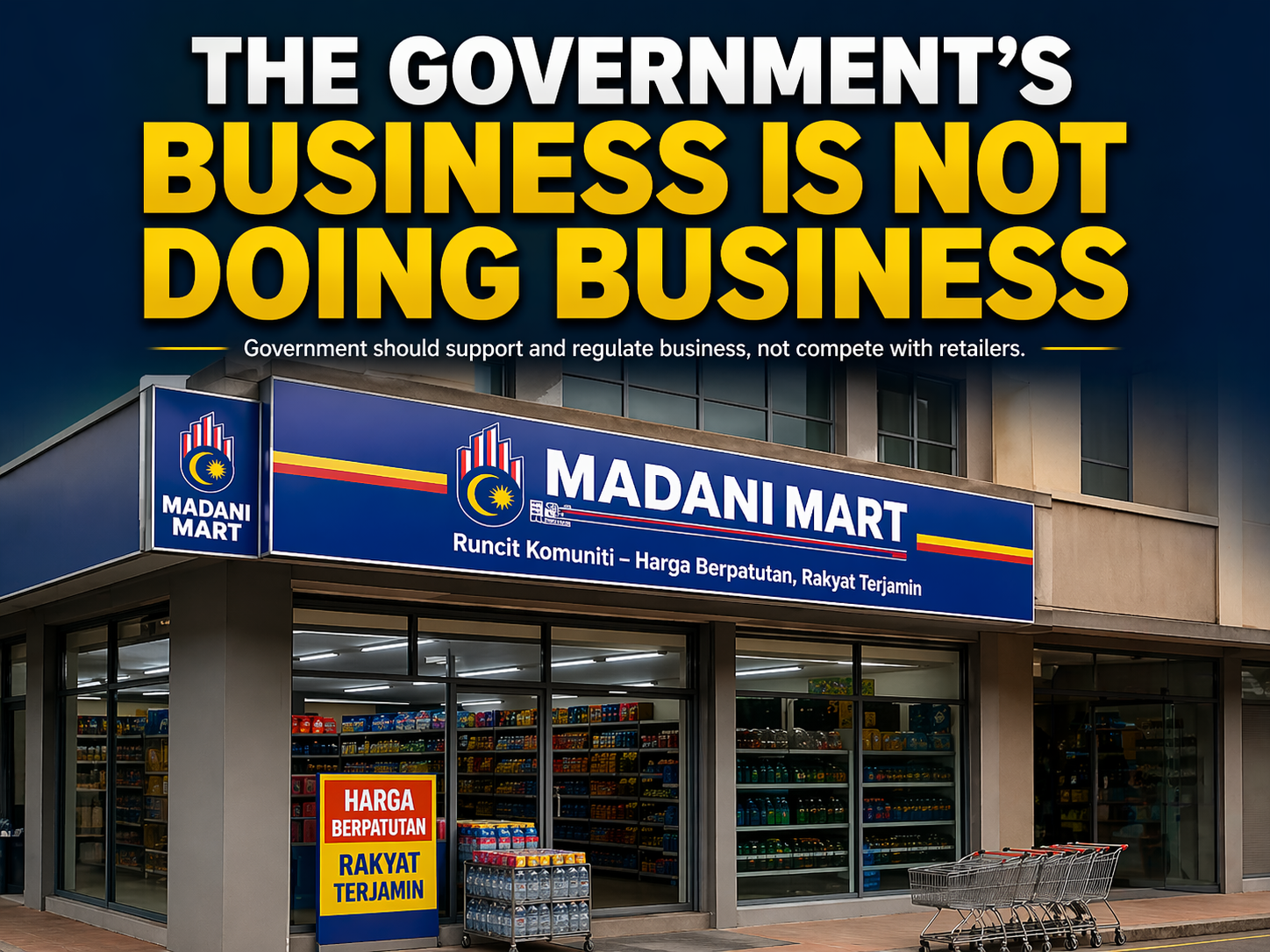
My concern about Madani Mart is not merely about whether one shop can sell cheaper goods. This article is written in light of Datuk Ameer Ali Mydin’s interview in BFM last week. It is certainly a much bigger issue on what I heard on snippets of the said interview and that reminds me on the proper role of Government.
Allow me to stress that the Government’s business is not to do business. The Government’s role is to govern, regulate, facilitate, supervise, enable and create a fair economic environment where businesses, entrepreneurs and retailers can grow. The Government should not be seen as entering the market, directly or indirectly, to compete with existing retailers.
That, to me, is the most important point.
I fully understand the intention behind Madani Mart. The objective is noble. It wants to make essential goods cheaper, help the rakyat manage the cost of living, and create opportunities for entrepreneurs to operate under a common retail banner. Public reports have described Madani Mart as a licensing model, where Yayasan Madani is the brand owner managing the ecosystem, including training, systems, pricing, retail analysis and supply chain support, while each outlet is privately owned and operated in each and every DUN in the country
So, on paper, it sounds attractive for the ordinary rakyat/consumer.
But business is not sustained by good and noble intention. Business is sustained by numbers and figures.
Retail is a very unforgiving business. Many of my clients did it with seriously LOW or razor thin Margins. Rental is real. Salaries are real. Utilities are real. Wastage is real. Expired goods are real. Shrinkage is real. Stockholding cost is real. Logistics cost is real. Competition, and I stress is BRUTAL, survival of the fittest.
That is why Datuk Ameer Ali Mydin’s warning must not be dismissed lightly.
He is not speaking from theory. Mydin had direct experience with Kedai Rakyat 1Malaysia. The Edge reported that KR1M ceased operations in 2017, and that MRT Retail, which operated close to 200 KR1M outlets, had accumulated losses of RM128.15 million by FY2017 after six consecutive years of losses (The Edge)
So, when Datuk Ameer says that opening one outlet in every state constituency is a political decision rather than a business decision, I think the comment deserves serious reflection. The Edge reported that he raised this concern in relation to Madani Mart, particularly because of thin retail margins and the difficulty of competing with large players.
Are we building a sustainable retail model, or are we building a politically attractive network of outlets?
This is the heart of the issue.
A political decision may say: “Every constituency must have one outlet.”
A business decision will ask, not just, “Can this outlet survive?” but many questions below:-
Can it achieve enough sales?
Can it maintain sufficient margin?
Can it control rental?
Can it afford manpower?
Can it manage stock turnover?
Can it reduce wastage?
Can it compete with established retailers?
Can the operator actually make money after all expenses?
Those are business questions.
If the answer is not clear, then opening more outlets does not solve the problem. It multiplies the problem.
Public reports I gathered state that Madani Mart aims to have one outlet in each state constituency and is setting up distribution centres to support clusters of outlets. Yayasan Madani has also said expansion will be driven by pipeline readiness and supply chain strength. That is the correct language. But the real test is not the announcement. The real test is execution. Because in retail, supply chain is not a slogan. It’s everything.
If the supply chain is weak, the outlet suffers. If procurement is weak, prices cannot remain competitive. If stock movement is weak, cash flow suffers. If distribution is inefficient, the operator pays the price. If the outlet cannot access the same back margins, rebates and supplier support enjoyed by major retailers, then the small operator is already fighting with one hand tied behind his back. Compare to large retailers like a franchise or a corporate chain.
Let us look at the numbers
Assume one outlet does RM200,000 sales a month.
If the front margin is 10%, the gross margin is RM20,000. Why because Madani Mart supposed to sell cheap! Not reasonable BUT Cheap!
From that RM20,000, the operator may need to pay staff salaries of RM2,000.00 for 5 staffs, that will be RM10,000. Rental may be RM5,000 to RM6,000. Not forgetting, an outlet is not enough for a Madani Mart, a possible of two outlet. That somewhat increases rental. Then there are utilities, EPF, SOCSO, insurance, repairs, accounting, licence fees, transport, wastage, expired goods, theft, bank charges, financing cost and other overheads.
What is left?
And if nothing meaningful is left, then what exactly is the entrepreneur investing into?
This is where noble intention becomes dangerous. If the model is not commercially viable, the Government may think it is helping entrepreneurs, but in reality it may be pushing them into a business model where survival is extremely difficult.
A REPEAT OF KR1M?
Again, the Government’s business is not to do business.
The Government should not create a situation where existing retailers feel they are competing not merely with another shop, but with a government-linked, policy-backed or nationally endorsed retail banner.
That distorts the market.
The Government should be the referee, not the player.
The Government should set the rules, improve competition, reduce leakages, strengthen supply chains, remove unnecessary barriers, support existing entrepreneurs, help small retailers modernise, improve access to financing, encourage cooperative purchasing, and provide targeted assistance to consumers.
That is the proper role of Government.
If the objective is to reduce the cost of living, there are many possible tools.
The Government can strengthen enforcement against profiteering.
The Government can improve competition policy.
The Government can support small grocers with digitalisation grants.
The Government can create shared procurement platforms.
The Government can support cooperatives.
The Government can assist existing retailers to access better supply terms.
The Government can provide targeted vouchers directly to consumers.
The Government can improve logistics infrastructure.
The Government can reduce leakages in the supply chain.
The Government can support local producers and connect them to retailers.
All these strengthen the market.
But once the Government, directly or indirectly, starts building a retail banner, managing the brand, influencing pricing, coordinating supply chain and rolling out outlets under a national policy narrative, then the line becomes very thin. Is the Government facilitating business? Or is the Government entering business?
To be fair, Yayasan Madani has publicly said Madani Mart is not the same as KR1M, that it does not rely on government funding, and that each outlet is individually owned and operated by the operator.
Fair enough.
It may not be the same model as KR1M. But that does not mean we should ignore the KR1M lesson. It would be unfair to say Madani Mart must fail just because KR1M failed. But it would also be irresponsible to ignore the reasons why KR1M struggled. The lesson from KR1M is not merely about the name of the programme. The lesson is about retail reality.
Retail is not just opening a shop, putting goods on shelves and selling at cheaper prices. I deal with clients having retails and is about procurement, pricing, logistics, stock turnover, category management, supplier support, manpower scheduling, wastage control, shrinkage control, rental discipline, cash flow management and customer frequency.
A shop may be full on opening day. The public may come because it is new. The cameras are there. And when cameras are around, here comes the politicians. But what happens after three months? What happens after six months? What happens when the novelty is gone? What happens when stock does not move? What happens when rent and salaries are due?
What happens when cheaper goods cannot be consistently supplied?
What happens when the operator realises that high sales do not necessarily mean profit?
What about the prototype, profitable? What about Legal Structure?
Before Madani Mart talks about opening hundreds of outlets nationwide, the first question must be: “Where is the proven prototype?”
A first outlet is not automatically a prototype. It may only be a pilot. A prototype must be tested, measured and proven profitable under normal trading conditions — not merely during launch publicity.
The real questions are:
Can the outlet make consistent sales?
Can it maintain affordable prices and still make profit?
Can it pay rent, staff, utilities and wastage?
Can the operator earn a reasonable return?
Can the model be repeated in another location by another operator?
Until these questions are answered with real numbers, any expansion is risky.
Then a crucial question comes next after prototype, so, if Madani Mart is truly only licensing, then of course the legal structure must be clear.
What are the rights of the operators?
What are the obligations of Yayasan Madani?
What control does the brand owner have?
What consideration is paid?
What happens if the outlet fails?
What happens if supply is interrupted?
What happens if pricing cannot be maintained?
What happens if the operator wants to exit?
What happens if the model later falls within franchise regulation?
These are not small questions.
They are important because the entrepreneurs will have to:
invest their savings?
borrow money?
signing rental agreements?
employ staff?
rely on Yayasan’s promises of support, supply chain and pricing.
That is why I say this carefully but firmly: Madani Mart should not become a symbol of Government competing with retailers. It should not become a retail experiment where entrepreneurs carry the risk while policy makers enjoy the announcement. It should not become another example of noble intention meeting harsh business reality. The Government should not be in the business of running, promoting or indirectly competing in retail.
The Government should be in the business of strengthening the retail ecosystem.
If Madani Mart succeeds commercially, then good. The rakyat benefits, operators benefit, and Malaysia may discover a new community retail model.
But if it is politically driven, if it expands before the numbers are proven, if operators cannot make money, if the supply chain cannot support the promise, and if existing retailers are indirectly forced to compete with a Government-associated banner, then it risks becoming one of Madani’s biggest failures.