
In the world of franchising, legal disputes are not only inevitable but also inherently complex. These disputes often arise from breaches of contract, operational disagreements, or perceived failures in the franchisor-franchisee relationship. When such disputes occur, the resolution process is typically governed by a series of contractual clauses—most notably those concerning governing law, jurisdiction, arbitration, and increasingly, mediation. A well-drafted Franchise Agreement anticipates potential conflicts and provides a structured pathway for resolution. However, the interplay between these clauses can sometimes create unexpected procedural challenges, particularly when urgent legal intervention is required.
Most Franchise Agreements include a governing law clause, which specifies the applicable legal system for interpreting and enforcing the agreement. In cross-border arrangements, this clause brings predictability and ensures that parties understand the legal framework within which they are operating. Complementing this is the jurisdiction clause, which commonly confers exclusive jurisdiction on the courts of a specified country—typically the franchisor’s domicile—for matters involving equitable relief, such as injunctions or specific performance. These remedies are vital in protecting the franchisor’s brand, confidential information, and intellectual property, especially when immediate action is needed to prevent irreparable harm to the franchise system.
At the same time, most agreements include a mandatory arbitration clause, which requires that all other disputes be resolved through arbitration. Arbitration offers several advantages, including privacy, procedural flexibility, and the selection of industry-knowledgeable arbitrators. However, despite these benefits, arbitration can be problematic in time-sensitive situations. Unlike courts, arbitral tribunals generally lack the power to grant immediate binding orders such as injunctions or interim relief. Moreover, setting up arbitration proceedings—appointing arbitrators, agreeing on procedural rules, and scheduling hearings—can take considerable time and may not align with the urgency of the dispute.
This tension between court access and arbitration obligations is often most pronounced in disputes involving alleged failures by the franchisor to provide ongoing support and assistance—a core obligation in any franchise relationship. Franchisees expect, and are often contractually entitled to, training, marketing assistance, operational guidance, and technical support. When these are not delivered, the franchisee’s business may suffer, leading to demands for immediate legal redress.
A recent case provides a clear illustration of the practical challenges involved. A franchisee, facing severe business disruption due to alleged support failures, sought urgent relief in court. However, the Franchise Agreement contained a strict arbitration clause with no express exception for court action in such scenarios. As a result, the franchisor responded by invoking the arbitration clause and applying to stay the court proceedings. Under most legal systems, courts are bound to honor valid arbitration agreements, unless both parties agree to waive arbitration. Recognizing the urgency, both parties eventually executed a mutual waiver, allowing the matter to proceed in court. This episode underscores the importance of drafting arbitration clauses with procedural flexibility and highlights the need for strategic foresight when navigating dispute resolution processes.
In recent years, some franchisors have begun to incorporate mediation clauses into their agreements, requiring parties to attempt mediation before arbitration or litigation. While mediation remains relatively novel in the Malaysian franchise context, its use is growing. Although the Franchise Act 1998 does not expressly provide for mediation, KUSKOP and the Malaysian Franchise Association (MFA) have taken proactive steps by offering mediation services for franchise disputes. Mediation offers several benefits: it is cost-effective, preserves business relationships, and provides a confidential setting where parties can explore mutually acceptable solutions. While not binding unless a settlement is reached, mediation can prevent the escalation of disputes and the associated costs of formal proceedings.
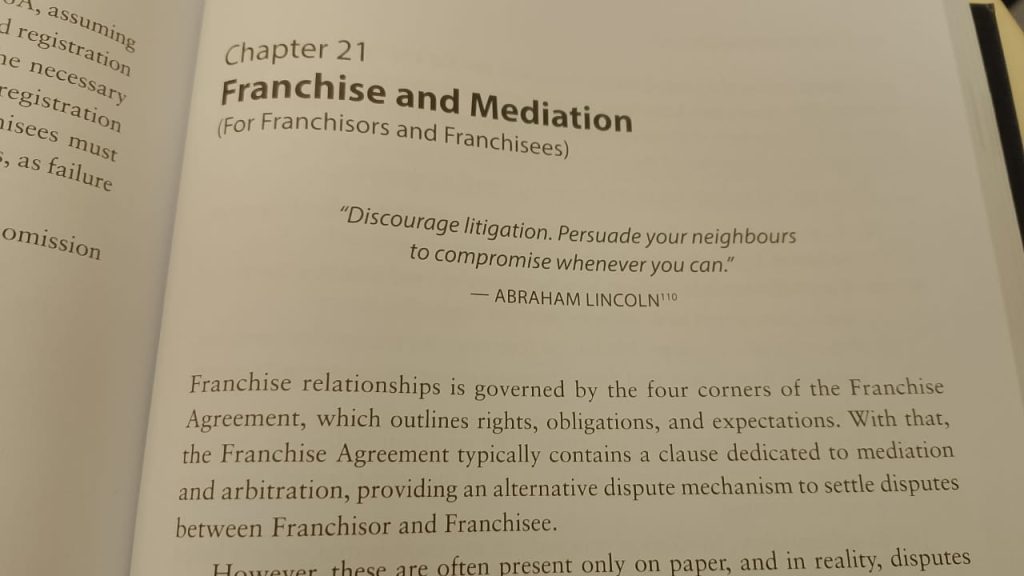
In my book, The Franchise Code: Start, Structure & Scale Your Franchise in Malaysia, I have dedicated a section from page 325 onwards to the importance of mediation in franchising, and I have expressed hope that the Malaysian government will develop a formal, robust mediation framework for franchise disputes. A structured mediation process could reduce the burden on courts, promote faster resolutions, and preserve the integrity of franchise relationships.
Given the increasingly complex nature of franchise disputes, it is imperative that Franchise Agreements be drafted with practical dispute resolution mechanisms. Key recommendations include: (1) including clear carve-out clauses permitting immediate court action for equitable relief; (2) providing for mutual waiver of arbitration by written agreement to enable flexibility; (3) defining support and assistance obligations in precise terms to avoid ambiguity; and (4) considering the inclusion of mandatory mediation as an initial step in dispute resolution. These provisions ensure that parties are not procedurally trapped when urgency demands action and that disputes can be managed efficiently and effectively.
Ultimately, franchising is a relationship-based business model. At its core, it relies on trust, cooperation, and mutual success. When disputes arise, it is essential for parties to set aside egos and seek solutions that preserve the relationship and the integrity of the franchise system. Litigation should be a last resort, not the first response. Where possible, disputes should be resolved amicably, through mediation or direct negotiation, with a view toward achieving win-win outcomes. A combative legal approach often leads to financial strain, reputational damage, and the erosion of goodwill on both sides. By approaching disputes strategically and with the right procedural tools, franchisors and franchisees can protect their interests while preserving the value and sustainability of the franchise relationship.